
Philippine Educational Certificate Attestation
Philippines Degree Attestation
Philippine educational certificate attestation for the UAE is a 4-step legalization process: CHED CAV, DFA Apostille, UAE Embassy Manila, MOFA UAE. This chain applies to all Philippine educational documents university degrees, diplomas, transcripts (TOR), PRC professional licenses, TESDA National Certificates, and DepEd school records. The Philippines joined the Hague Apostille Convention on 14 May 2019, replacing the old “Red Ribbon” with the DFA Apostille. However, since the UAE is not a Convention member, a DFA Apostille alone is not accepted full legalization including UAE Embassy attestation is required.
GloboPrime manages this entire process from our Dubai office with dedicated partners in Manila, Cebu, and Davao. The UAE is the second-largest destination for OFWs (PSA, 2024) we process Filipino educational documents every day. 12+ years of experience, 1,461+ verified reviews (4.9★), and English to Arabic legal translation.
What Is CHED CAV (Certification, Authentication and Verification)?
Note: The DFA will not Apostille any educational document without the CHED CAV. Submitting a diploma or TOR directly to the DFA without the CAV will result in outright rejection. This is the #1 reason for application delays and the most common issue Filipino professionals in the UAE face when attempting to process attestation without professional guidance.
What Is the DFA Apostille? (Replaced the “Red Ribbon”)
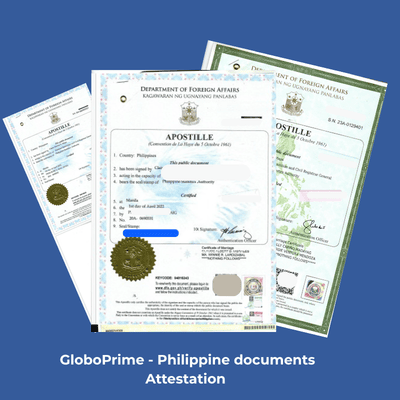
The DFA Apostille is the official authentication certificate issued by the Department of Foreign Affairs — Office of Consular Affairs (DFA-OCA) that replaced the old “Red Ribbon” authentication since 14 May 2019 (dfa.gov.ph). The DFA stopped affixing red satin ribbons on 15 June 2019. The Apostille certifies the origin and authenticity of Philippine public documents for use abroad. For educational documents, the DFA will only issue an Apostille if a CHED, TESDA, or DepEd CAV is attached — documents without CAV are rejected at the DFA counter.
DFA Apostille fees and processing (apostille.gov.ph): Regular processing — PHP 100, released after 5 working days. Expedited processing — PHP 200, released after 2 working days. Online appointment required via appointment.apostille.gov.ph (PHP 200 covers the first document). DFA main office: Bradco Avenue, ASEANA Business Park, Parañaque City. Also available at DFA satellite offices in Ali Mall, SM Megamall, SM Manila, and DFA offices in Cebu (Mandaue), Davao (Ecoland), and Cagayan de Oro.
Why DFA Apostille is not enough for the UAE: The UAE is not a member of the Hague Apostille Convention. The DFA confirms: “If your public document is to be used in a country where the Apostille Convention does not apply, you should contact the Embassy or Consulate of the country where you intend to use the document.” After DFA Apostille, your educational document must still be attested by the UAE Embassy in Manila and then by MOFA UAE.
Philippine Educational Certificate Attestation Process for UAE
The attestation chain depends on the issuing authority. Higher education degrees go through CHED. Technical-vocational certificates go through TESDA. Basic education records go through DepEd. PRC professional licenses go through PRC. All converge at DFA → UAE Embassy → MOFA.
For Higher Education (Degree, Diploma, TOR)
Step 1: CHED CAV
Registrar endorses documents to CHED → CHED verifies and issues CAV in sealed envelope → PHP 80, 5–15 working days.
Step 2: DFA Apostille
Submit sealed CHED-CAV envelope to DFA-OCA → PHP 100 regular (5 days) or PHP 200 expedited (2 days) → Online appointment: appointment.apostille.gov.ph.
Step 3: UAE Embassy Attestation in Manila
UAE Embassy verifies DFA Apostille → Required because UAE is not Hague member → 3–5 working days.
Step 4: UAE MOFA Attestation
Final digital attestation with QR code → AED 150 per educational document → mofa.gov.ae (UAE Pass required) → 1–3 business days.
For TESDA Certificates (NC I–IV, COC)
TESDA CAV → DFA Apostille → UAE Embassy Manila → MOFA UAE (AED 150).
For DepEd Records (Form 137, High School Diploma)
DepEd CAV → DFA Apostille → UAE Embassy Manila → MOFA UAE (AED 150).
For PRC Professional Licenses (Nurses, Engineers, Teachers, CPAs)
PRC Certification → DFA Apostille → UAE Embassy Manila → MOFA UAE (AED 150). For DHA/DOH healthcare licensing, both the attested degree AND attested PRC license are required — GloboPrime handles both simultaneously.
Philippine Educational Documents We Attest
- University Degrees & Diplomas: From UP, UST, Ateneo, DLSU, FEU, Mapúa, PUP, TUP, CEU, Adamson, and all CHED-recognized institutions. CHED CAV required.
- Transcript of Records (TOR): Must be attested alongside the degree. CHED verifies both.
- PRC Professional License: Nurses (PRC-RN), engineers (PRC), teachers (PRC-LET), CPAs, architects, pharmacists. Separate attestation chain from degree.
- TESDA National Certificates: NC I through NC IV and COC. Uses TESDA CAV.
- MARINA Certificate of Competency: For seafarers and maritime professionals.
- School Transfer Certificate & DepEd Form 137: Uses DepEd CAV.
- Diplomas from Closed Institutions: Special CHED-CAV process with notarized request letter.
Certificate Attestation Services in UAE
TESDA CAV for National Certificates and Certificates of Competency
TESDA CAV is the Certificate of Authentication and Verification issued by the Technical Education and Skills Development Authority for National Certificates (NC I, NC II, NC III, NC IV) and Certificates of Competency (COC) earned through TESDA-registered assessment centers. CHED cannot authenticate TESDA-issued qualifications, and TESDA cannot authenticate CHED-issued degrees. Each agency handles only its own credential type.
TESDA CAV is required for Filipino workers in the UAE holding qualifications in caregiving, welding, automotive servicing, electrical installation, cookery, food and beverage services, housekeeping, plumbing, computer hardware servicing, and all other TESDA-registered programs. Maritime seafarers holding TESDA-issued COCs (covered under the Maritime Labour Convention) follow the same CAV process at the TESDA office that issued their COC.
Process (per tesda.gov.ph/About/TESDA/46):
Step 1: Go to the TESDA Provincial or District Office that issued your NC or COC.
Step 2: Submit the original NC/COC and two (2) photocopies.
Step 3: Pay the authentication fee of PHP 50 to the Cashier and receive the Official Receipt.
Step 4: Present the Official Receipt to the TESDA Issuing Office for CAV processing.
Step 5: Collect the CAV document from the TESDA Office.
Important: The CAV is released directly to the applicant (unlike CHED CAV which goes through the HEI). However, if claiming through a representative, a Special Power of Attorney (SPA) from the applicant is required. NC/COC documents must be released directly to the applicant or their SPA-authorized representative.
For TESDA-registered programs offered by Work Education and Training (WET) institutions, a separate CAV procedure applies with a fee of PHP 30 per the TESDA Circular on Revised Implementing Guidelines. The WET institution’s jurisdiction determines which TESDA Provincial Office processes the CAV.
DepEd CAV for Elementary and Secondary School Records
DepEd CAV covers authentication of records from public and private elementary schools, secondary (junior and senior high school) programs, and the Alternative Learning System (ALS). The Department of Education handles CAV for the following document types:
Elementary or Secondary Diploma, Form 137 (Permanent Record / Learner’s Scholastic Record), Form 138 (Report Card), Report of Rating for the Accreditation and Equivalency Test (ALS), and the Philippine Educational Placement Test (PEPT) results.
DepEd CAV is required for UAE purposes including school enrollment transfers (when moving a child from a Philippine school to a UAE school and the receiving institution requires authenticated records), family visa processing where a dependent’s educational history must be verified, and certain entry-level employment situations where secondary-level completion must be proven to UAE labour authorities.
The processing requirements and timelines vary by DepEd Regional or Division Office. GloboPrime coordinates with the specific DepEd office that has jurisdiction over the school where the records were issued.
Any Certificate Attestation from the following Countries





Philippine Consulate in Dubai
Philippine Consulate General in Dubai: Attestation Services Overview
The Philippine Consulate General in Dubai provides attestation-related services through its Notary section. These include attestation of DFA Authentication Certificates, attestation of MOFA stickers placed on Philippine documents, and attestation of documents executed by foreign nationals such as Special Powers of Attorney, contracts, and agreements.
For Philippine educational documents intended for use in the UAE, the attestation process follows a structured government chain. This typically involves Certification, Authentication and Verification (CAV) by the relevant authority (CHED, TESDA, or DepEd), followed by DFA Apostille, UAE Embassy attestation in Manila, and final MOFA attestation in the UAE. This sequence ensures that the document is recognized by UAE authorities.
Consulate hours: Monday to Thursday, 7:30 AM to 3:30 PM, and Friday, 7:30 AM to 12:00 NN (excluding legal holidays). Notarial and attestation services are processed by prior appointment through the Consulate’s official appointment system.
Applicants residing in the UAE may coordinate the Philippine-side processing through authorized representatives or professional attestation service providers to complete the required steps efficiently before final MOFA attestation in the UAE.
Professional Translation Services in Dubai:
Need Philippine documents translated? Our certified legal translators handle Filipino/Tagalog–Arabic and Filipino–English translations approved by UAE courts and all government authorities.
Ready to Get Started?
Contact GloboPrime today for a free consultation and personalized quote. We’ll guide you through the process and ensure your documents are attested accurately and efficiently. Visit our office or call us today!

Request a Quote
Request an individual quotation. We'll assess your requirements and get back to you within one working hour.

Request a Callback
Fill in the form to request a callback. One of our specialist advisors will call you back as soon as possible.

Get in touch with us on Whatsapp if you prefer! Message us on +971564625222 to get started. Text only.